
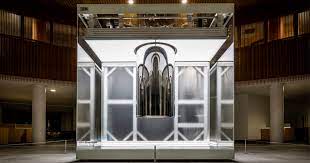
On Monday, Cleveland Clinic and IBM announced the launch of what they describe as a potentially game-changing quantum computing venture that might accelerate medical research.
The new IBM Quantum System One, which is currently being used at Cleveland Clinic, is being hailed as the country’s first privately operated on-site quantum computer and the first of its kind worldwide to be used exclusively for medical research.
Researchers said the idea is to use Cleveland Clinic’s exceptional computational capacity to speed up scientific discoveries related to a variety of clinical and pharmaceutical demands.
The enormous new computer is a component of the Cleveland Clinic-IBM Discovery Accelerator project, which was first announced in 2021 with the intention of assisting researchers from both organizations work cooperatively to apply cutting-edge technologies to enormous datasets for improved research insights, including high performance computing via the hybrid cloud and artificial intelligence.
The accelerator’s current projects include the development of quantum computing pipelines to screen and optimize medications targeted to particular proteins, enhanced quantum-enhanced cardiovascular risk prediction models following non-cardiac surgery, and AI applications to search large drug target databases and genome sequencing data for more potent Alzheimer’s medications.
Health IT professionals have been looking at quantum computing as a possible game-changer for creating novel new medications and therapy interventions for more than a decade. The quickly growing technology promises significantly increased computer capability by utilizing quantum physics.
These devices work with so-called quantum bits, or qubits, which can exist in many states simultaneously or in what is known as “superposition”; they can be either ones or zeros. This means that, in contrast to conventional computers, which can only handle one task at a time, quantum machines can process numerous computations simultaneously, outperforming even the most sophisticated supercomputers.

“When you string several qubits together, instead of operating on one bit at a time, you can operate on the superposition of exponentially many bits at the same time,” one expert said in 2013. “There’s a fundamentally different mechanism available because you’re harnessing different physical principles.”
“The exponential computing speedup offered by quantum computers will enable machine learning algorithms to rapidly identify patterns in healthcare data collected from millions of participating patients,” another engineer said in 2019, explaining that medical imaging and pathology would be two areas poised to benefit immensely.
Cleveland Clinic and IBM first announced its 10-year Discovery Accelerator cooperation in 2021. With the intention of generating new jobs in quantum computing in the Cleveland area, the cooperation also placed a strong emphasis on education, training, and workforce development from the high school level onward.
“This is a pivotal milestone in our innovative partnership with IBM, as we explore new ways to apply the power of quantum computing to healthcare,” said Cleveland Clinic CEO Dr. Tom Mihaljevic in a statement announcing the deployment of IBM Quantum System One.
“This technology holds tremendous promise in revolutionizing healthcare and expediting progress toward new cares, cures and solutions for patients,” he said. “Quantum and other advanced computing technologies will help researchers tackle historic scientific bottlenecks and potentially find new treatments for patients with diseases like cancer, Alzheimer’s and diabetes.”
“With the unveiling of IBM Quantum System One at Cleveland Clinic, their team of world-class researchers can now explore and uncover new scientific advancements in biomedical research,” added IBM CEO Arvind Krishna. “By combining the power of quantum computing, artificial intelligence and other next-generation technologies with Cleveland Clinic’s world-renowned leadership in healthcare and life sciences, we hope to ignite a new era of accelerated discovery.”