
Radiologist vs AI, What it means for low and middle-income countries
The application of AI in radiology has the potential to revolutionize the way medical images are analyzed and diagnoses are made. This has significant implications, particularly for low and middle-income countries where access to skilled radiologists may be limited. Diagnostic imaging is a paramount for every clinical scenario. But in a country with such a shortage of radiologist (Example, Ethiopia <250 Radiologists for a population of >100,000,000) its a luxury, only few that can access and also afford it.
“...AI will not replace radiologists, rather, a radiologist who leverages the power of AI will replace those who don’t...”
One of the key ways in which AI is being applied in radiology is through the development of computer-aided detection (CAD) systems. These systems use algorithms to automatically analyze medical images and identify potential abnormalities. This can help radiologists to more quickly and accurately identify conditions such as tumors or fractures.
Here are some examples of how AI can be used in radiology in these countries:
In a rural clinic in a middle-income country, a CAD system is used to automatically analyze X-rays and other medical images, helping the clinic’s radiologist to more quickly and accurately identify potential abnormalities.
In a remote area of a low-income country, a mobile health clinic uses AI-powered imaging technology to diagnose conditions such as pneumonia and malaria, improving the accuracy of diagnoses and ensuring that patients receive the appropriate treatment.
A medical research center in a middle-income country uses AI to analyze large amounts of data from medical images and identify patterns that may indicate the presence of a particular condition. This helps researchers to better understand the underlying causes of diseases and develop new treatments.
In a low-income country hospital, a smart imaging system is used to provide early warning signs of conditions such as cancer or heart disease, helping doctors to diagnose and treat these conditions in a timely manner.
Here are a few specific examples where AI is being implemented in African countries:
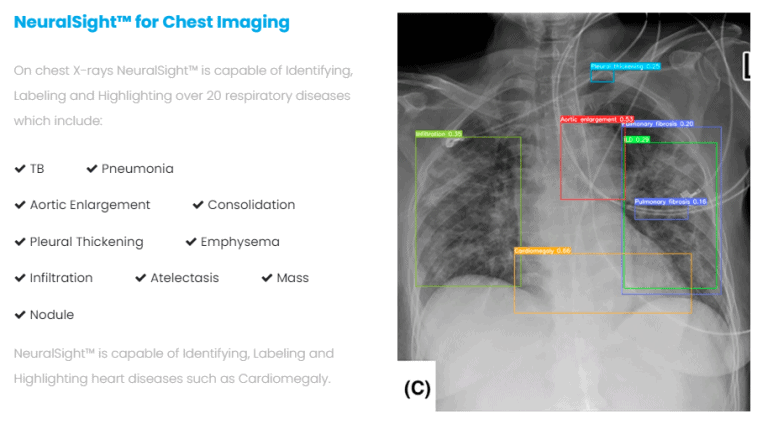
Neural Labs, founded in January 2021 by Tom Kinyanjui and Paul Mwaura Ndirangu, is a machine learning engineering company that has developed a platform called NeuralSight. This platform is designed to reduce Africa’s disease burden and hospital workloads, ultimately leading to better patient outcomes and increased access to healthcare. The founders of Neural Labs are both machine learning engineers, and they saw an opportunity to use AI to address some of the challenges facing healthcare in African countries.

Envisionit Deep AI is a medical tech firm that uses artificial intelligence to make medical imaging diagnosis more efficient and accurate for radiologists. This South African start-up Envisionit has developed technology called RADIFY, that can scan more than 2,000 x-rays per minute!
Overall, the use of AI in radiology has the potential to greatly improve diagnostic accuracy and efficiency in low and middle-income countries, ultimately leading to better health outcomes for patients.
In the video below, you will see Chris Haarburger (a machine learning expert) and Dr. Christoph reviewing a fracture detection algorithm “BoneView” from Gleamer.