
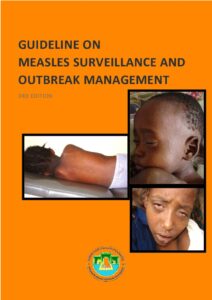
What this document is
This page hosts the full PDF of Ethiopia’s Guideline on Measles Surveillance and Outbreak Management, Third Edition. The file runs to 72 pages. It covers the whole chain from recognising measles clinically, through case-based surveillance and laboratory confirmation, to running an outbreak investigation in the field.
Measles, clinically
The first chapter sets out the background to measles control, the mode of transmission, and the clinical features: pathogenesis, incubation period and period of infectivity, symptoms and signs, differential diagnosis, complications, and case fatality. For a clinician seeing a rash and fever, the differential diagnosis and complications subsections are the working part.
Accelerated control strategies
Chapter 2 covers routine immunisation, including vaccine storage, contraindications, and adverse events following immunisation, then the second opportunity for vaccination. This is where the programme side of measles control is defined.
Case-based surveillance
The surveillance section gives the measles standard case definitions, how to report, analyse and interpret the data, how laboratory investigation works, and how a measles case is finally classified. The standard case definitions and the case classification rules are the two pieces that have to be applied consistently for national data to mean anything.
Case management
The guideline covers contact with cases, clinical assessment, and the treatment of uncomplicated and complicated measles as separate procedures. Complicated measles is treated as its own pathway rather than an escalation of the uncomplicated one.
Outbreak investigation, step by step
Chapter 3 is a field manual in ten steps: prepare for field work, establish that an outbreak exists, verify the diagnosis, identify additional cases, analyse the data by person, place and time, develop a hypothesis, evaluate it, refine it and carry out additional measures, implement control and prevention measures, and communicate the findings.
Control measures during an outbreak
The control step breaks down into implementing case management, reinforcing routine vaccination, implementing selective or non-selective vaccination, and measles prevention and control in emergency settings. The emergency subsection matters in Ethiopia, where displacement and drought regularly overlap with measles transmission.
Communication and monitoring
The closing chapters cover effective communication for behaviour change and the monitoring of the programme. Chapter 4 is short, and it is the part most often skipped, though vaccination refusal is a communication problem before it is an epidemiological one.
Related documents in the Hepius library
See also the National Public Health Emergency Operations Centre Handbook, the Third National Neglected Tropical Diseases Strategic Plan 2021-2025, and the National Malaria Guidelines.
Get new Ethiopian clinical guidelines by email
One short message when a new national guideline, protocol or standard is added to this library. The download above stays free either way.
No spam, unsubscribe any time. Privacy policy.
Related documents
Other guidelines and protocols on the same subject.