
What this document is
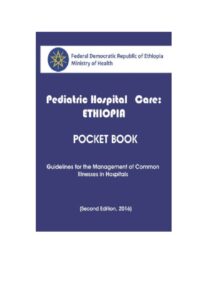
This page hosts the full PDF of Pediatric Hospital Care: Ethiopia Pocket Book, Guidelines for the Management of Common Illnesses in Hospitals, Second Edition, 2016, from the Federal Ministry of Health. The file runs to 526 pages. It is the national bedside reference for doctors, nurses and health officers who admit and treat sick children in Ethiopian hospitals.
Where it comes from
The acknowledgements explain that this second edition was adapted from the WHO Pocket Book of Hospital Care for Children (2013), with technical and financial support from WHO Ethiopia. The authors say they worked to bring every treatment recommendation into line with the national care and treatment guidelines in force at the time, and they single out emergency triage and treatment at referral hospitals as the area they most wanted to improve.
Triage, emergencies and the first assessment
Chapter 1 covers triage and emergency conditions: airway and breathing, circulation, dehydration, cardiopulmonary resuscitation, trauma, burns and common childhood poisoning. Chapter 2 sets out the diagnostic approach to the sick child, including how it relates to IMNCI, history taking, examination, laboratory tests and differential diagnosis.
Newborns and young infants
Chapter 3 is one of the longest. It runs from routine care at delivery and neonatal resuscitation through to hypoxic ischaemic encephalopathy, danger signs, convulsions, serious bacterial infection and neonatal meningitis. It also covers preterm and low-birth-weight babies, Kangaroo Mother Care, discharge and follow-up, and babies born to mothers with infections.
The common presenting problems
The middle chapters are organised by what the child arrives with. Chapter 4 covers cough or difficult breathing: pneumonia and its complications, wheeze, stridor, chronic cough and heart failure. Chapter 5 covers acute and persistent diarrhoea and dysentery. Chapter 6 covers fever, including malaria, meningitis, measles, septicaemia, typhoid, urinary tract infection, relapsing fever, rheumatic fever and dengue.
Malnutrition, HIV and surgery
Chapter 7 deals with severe acute malnutrition, from diagnosis and admission criteria to treating complications, routine medicines, dietary treatment and failure to respond. Chapter 8 covers children with HIV, including antiretroviral therapy, related conditions, infant feeding and palliative care. Chapter 9 covers common surgical problems: care around surgery, congenital anomalies, injuries and abdominal problems.
Supportive care, monitoring and discharge
Chapters 10 to 12 cover the care that surrounds treatment: feeding and breastfeeding support, fluids, fever and pain control, anaemia, oxygen therapy and play. They then set out how to monitor a child’s progress and when and how to discharge, with counselling for the family. The annexes carry practical procedures, drug doses and regimens, equipment sizes, intravenous fluids, nutritional assessment and blood pressure levels for boys and girls.
Related documents in the Hepius library
See also the Emergency Triage Assessment and Treatment (ETAT+ Ethiopia) Manual for Participants, which trains staff in the triage approach used in Chapter 1, and the National Guideline for the Management of Acute Malnutrition (May 2019).
Get new Ethiopian clinical guidelines by email
One short message when a new national guideline, protocol or standard is added to this library. The download above stays free either way.
No spam, unsubscribe any time. Privacy policy.
Related documents
Other guidelines and protocols on the same subject.
- Ethiopia Standard Treatment Guidelines for General Hospitals (Third Edition, 2014)PDF
- Ethiopia Standard Treatment Guideline for Primary Hospitals (Third Edition, 2014)PDF
- Standard Treatment Guideline for General HospitalPDF
Most downloaded in the library
Every document listed here is hosted on this site and downloads immediately.