
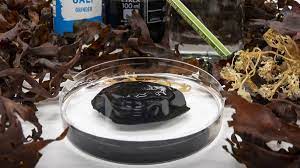
The Sussex team used seaweed, water, rock salt, and graphene to create the new health sensors, which could be worn by patients or athletes to track their temperature and heart rate. The sensors are totally biodegradable and more environmentally friendly than conventional rubber and plastic-based equivalents because they are created exclusively from natural substances. They also fall under the newly growing category of edible electronics, which deals with safe-for-human-consumption electronic gadgets.
Even better, the researchers discovered that the sensitivity of their eco-friendly seaweed-based sensors is actually higher than that of current synthetic hydrogels and nanoparticles used in wearable health monitors. Increasing the accuracy as a result, since a sensor’s sensitivity determines how correctly it records a person’s vital signs.
Lead researcher Dr. Conor Boland, a physicist at the University of Sussex, had the idea to utilize seaweed in a health monitoring device when he was watching TV during lockdown.
Lead researcher Dr. Conor Boland, a physicist at the University of Sussex, had the idea to utilize seaweed in a health monitoring device when he was watching TV during lockdown.
Dr Conor Boland, a materials physics lecturer in the School of Mathematical and Physical Sciences, said: “I was first inspired to use seaweed in the lab after watching MasterChef during lockdown. Seaweed, when used to thicken deserts, gives them a soft and bouncy structure — favored by vegans and vegetarians as an alternative to gelatin. It got me thinking: “what if we could do that with sensing technology?.”
“For me, one of the most exciting aspects to this development is that we have a sensor that is both fully biodegradable and highly effective. The mass production of unsustainable rubber and plastic based health technology could, ironically, pose a risk to human health through microplastics leeching into water sources as they degrade.
“As a new parent, I see it as my responsibility to ensure my research enables the realization of a cleaner world for all our children.”
Seaweed is primarily an insulator, but the researchers were able to produce an electrically conductive layer by adding a significant amount of graphene to a seaweed mixture. The film quickly absorbs water when submerged in a salt bath, forming a supple, spongy hydrogel that is electrically conductive.
Future applications of the clinical-grade wearable sensors would resemble a second skin or a temporary tattoo in terms of weight, ease of application, and safety because they are comprised entirely of natural chemicals. This innovation has the potential to revolutionize health monitoring technologies. Without the usage of more often employed and potentially invasive hospital equipment, wires, and leads, this would considerably improve the overall patient experience.
Dr Sue Baxter, Director of Innovation and Business Partnerships at the University of Sussex, is excited about the potential benefits of this technology: “At the University of Sussex, we are committed to protecting the future of the planet through sustainability research, expertise and innovation. What’s so exciting about this development from Dr Conor Boland and his team is that it manages to be all at once truly sustainable, affordable, and highly effective — out-performing synthetic alternatives.
“What’s also remarkable for this stage of research — and I think this speaks to the meticulous ground-work that Dr Boland and his team put in when they created their blueprint — is that it’s more than a proof of principle development. Our Sussex scientists have created a device that has real potential for industry development into a product from which you or I could benefit in the relatively near future.”
This most recent scientific advancement comes after Sussex scientists published a roadmap for nanomaterial development in 2019. The document provided a strategy for researchers to use to optimize the creation of nanomaterial sensors.
A lead author working on the findings under Dr Boland’s supervision was Sussex MSc student, Kevin Doty.
Kevin Doty, a Masters student in the School of Mathematical and Physical Sciences, at the University of Sussex, said: “I taught chemistry previously, but decided I wanted to learn more about nanoscience. My gamble paid off, and not only did I enjoy it more than I expected, but I also ended up with an opportunity to utilize the information I had learned to work on a novel idea that has evolved into a first author publication as an MSc student. Learning about nanoscience showed me just how varied and multidisciplinary the field is. Any science background can bring knowledge that can be applied to this field in a unique way. This has led to further studies in a PhD studentship, opening up an all new career path I could not have previously considered.”