
What is HIPAA?
HIPAA (Health Insurance Portability and Accountability Act) is a federal law in the United States that establishes data privacy and security safeguards for medical records.
With the numerous health data breaches caused by cyber assaults on health insurers and providers in recent years, the law has gained more attention. Most people in the healthcare industry refer to HIPAA compliance as conforming to HIPAA Title II:
“To establish national standards for processing electronic healthcare transactions. It also requires healthcare organizations to implement secure electronic access to health data and to remain in compliance with privacy regulations set by HHS (Health and Human Services) which is a cabinet-level executive branch department of the U.S. federal government (equivalent to the Ministry of Health in Ethiopia)”.
Here, we are also concerned with Tittle II from all 5 sections of the law.
What kinds of information are protected under HIPAA?
The HIPAA Privacy Rule protects all personal health information (PHI), that is held or transmitted by an entity or its business associate (other non-healthcare professionals involved in patient’s medication, insurance, registration, liaison, etc…) This information can be held in any form, including digital, paper or oral.
What is considered PHI (personal health information)?
PHI includes but is not limited to the following:
- Patient’s name, address, birth date, identification number, biometric identifiers
- An individual’s past, present or future physical or mental health condition;
- Any care provided to an individual; and
- Past, present, or future payment for the care provided to the individual that identifies the patient or information for which there is a reasonable basis to believe could be used to identify the patient.
Example: medical records, lab reports, receipts, and bills
What is NOT considered PHI?
- Employment and education records
- Any data that does not identify or provide information that could identify an individual
Conditions in which disclosure is allowed
- If they are using the data themselves or transmitting it to another covered organ,
- Only when the client gives written consent
What happens if you break HIPAA rules?
Possible outcomes of violating the HIPAA rules could be the following
- You could face civil penalties and criminal charges depending on the individual scenario (the fines can be in cash, up to $250,000, or a time in prison up to 5 years)
- You could be terminated from your job and professional associations
- Or it can also be dealt with internally by an employer
Why do we need HIPAA-like regulations?
Since the beginning of medical practice, taking a patient’s history has been an important part of the healthcare experience. Even if the clinician relied solely on his/her memory to record such information in ancient times, some form of record-keeping of interaction between the clinician and patient has been central to providing care.
Patient privacy is a core element of good health care practice and trust towards the health sector. Hence, legislation and regulatory laws are key tools in protecting privacy.
Patients’ health data has never been more vulnerable recently since the start of the country’s digital transformation, which is heavily being implemented in the health sector. This can be evidenced by the lately released HSTPII (Health Sector Transformation Plan II) and the Digital Health Blueprint.
There is no question that our health sector needs to go through a digital transformation, but with proper precautions and regulations.
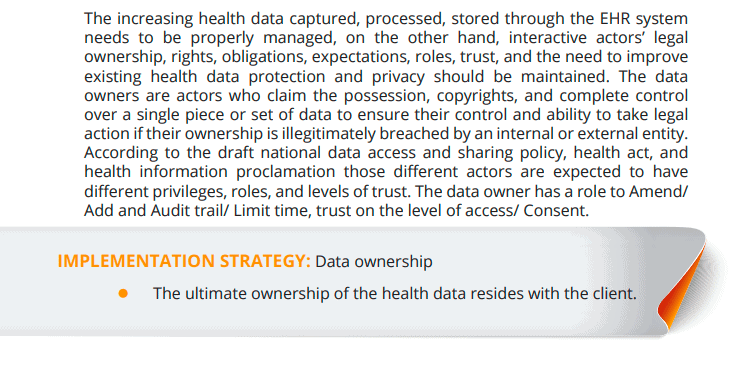
One of the documents prepared and released by MOH to address those issues was the “Standard for Health Record System (EHRs) in Ethiopia”. A very comprehensive standard addressing questions like, “is health information property?”, “Who owns the data?”, sharing health data, and more. (click here to download the standard book)
Not only it tries to address those sensitive questions but also states clearly the standards to follow when applying EHR for both private and public facilities. The implication of this is extremely significant. It saves money, energy, and unnecessary effort. This is a whole topic on its own.
Getting back to our current agenda, we need a HIPAA-like regulation. Yes, the standards are set, those using electronic services are following the guidelines and minimum standards. But what happens if they don’t? where is the legally binding regulation being implemented? Which private or public healthcare facility is a HIPAA complaint?
The level of risk for patients and the community as large is massive. Currently, thousands of healthcare data collected are in the hands of individuals, especially in private health care facilities. This data has very sensitive information on patients. Does anyone care to check if those facilities are taking the necessary precautions to protect that data, patients’ privacy?
“Facebook” at least asks for us to agree to its terms and privacy policies before using our personal data on what we like, dislike, what we are interested in, etc…
But these are healthcare data, they are even more sensitive, extremely private. Our illnesses, our laboratory and imaging results, our family medical histories, the medications we take…
No data can be 100% secure. The best these facilities can do is take precautionary measures and take responsibility when data breaches do occur. Even the most sophisticated securities of governmental organs are prone to penetration.
Outside of healthcare facilities, digital health care services are proliferating, without the necessary protective framework of health care data security and privacy.
it’s a great opportunity if it’s implemented early before the services become mainstream. It will be a great challenge to implement it later since privacy and security will be implemented as an afterthought after the service – which will always result in playing catchup.
This leads me to the point, we need a HIPAA-like regulation not only on a standard to be followed but also with proper legal backing that makes facilities work towards being compliant with the HIPAA.